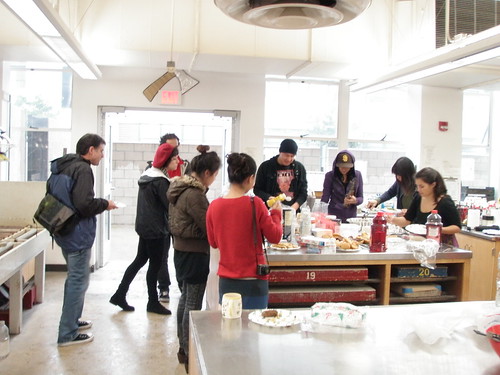
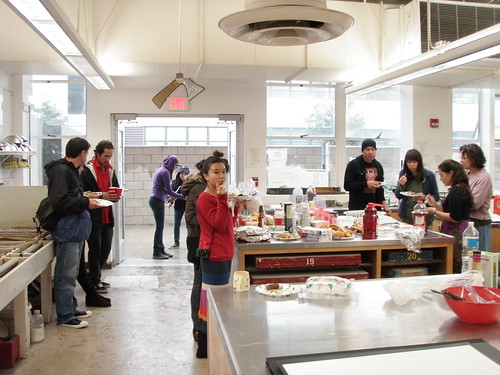

 This photo of my Relief Printing class from the summer of 2005 stands as concrete evidence of the joys of learning all things xylographical in beautiful Vermillion, South Dakota. (That's Christina Kaufmann, my lovely shop assistant, standing next to me in the blue T-shirt adorned with a white woodcut skull.) Truth be told, a panoply of printmaking classes are offered there, from notable practitioners in the field during the months of June and July. These classes can be transferred to work as credit towards your CSULB degree, but there is an extra fee that has to be paid to the University of South Dakota.
Rob Swainston: AH 365 Lecture Review, 10/6/2010, CSULB University Theatre
Rob Swainston is a co-founder and master printer at the printmaking studio Prints of Darkness in New York City.
Swainston’s own work is largely based on improvisation and revolves around print media although he does not stick to the traditional limits of the media. He “expanded the matrix” to the field of sculpture and installation by creating three dimensional pieces mainly constructed out of paper with the addition of various other materials. Swainston also likes to recycle his artwork by combining old and new elements. For example his Till Tomorrow On was first conceived as a large print titled Triumphal Arch, inspired by the woodcut The Triumphal Arch of Maximilian by Albrecht Dürer. In each subsequent gallery display of Swainston’s work, he would change some detail so that the resulting piece never looked identical to the original form. Swainston also said that he likes to photograph his installations and then create collages incorporating prints and photographs.
Rob Swainston explained that he largely operates on chance which might be the reason why his work lacks content. Swainston also said that he feels more challenged to work on pieces that he does not like by constantly reworking them without getting too preoccupied with the final meaning. This approach in art making is interesting although the lack of meaning does not seem fitting for reinterpretation of Dürer’s work.
In his lecture, the artist also explained that when he runs out of inspiration he uses a formula that he learned from his teacher: Use something found, combine it with the piece of a previous project and an action word. He explained that his decisions are made along the way. In Swainston’s opinion , art means creating something for the viewer and not yourself and, in his opinion, this approach distinguishes art from hobby. I wonder what other artists think about this definition, but I personally disagree.
I think that Swainston’s work has a certain visual appeal although it is difficult to judge prints by viewing them on the screen. The scale of his artwork is certainly impressive, but it lacks content. Also, the installations do not have the same appeal when shown as photographs.
Image: Centennial, from 2009, Woodblock print on paper installation, 10' tall, length variable